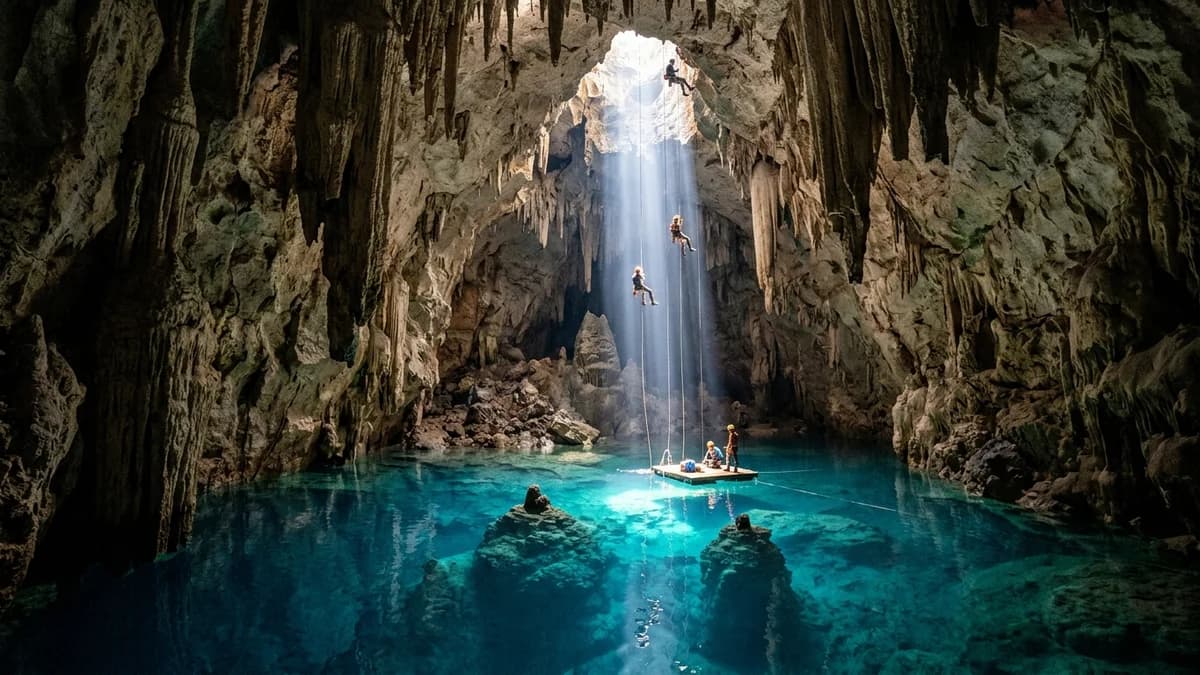
Hidden beneath the rolling pastures of Fazenda Anhumas, 23 kilometers from downtown Bonito (MS) and the welcoming sanctuary of Pousada Casa Azul, lies one of the most astonishing subterranean monuments on planet Earth: Abismo Anhumas. Approaching the surface entrance, the cavern appears as nothing more than a modest limestone slit in the rock, barely a meter and a half wide. Yet as adventurers cross this narrow threshold, the solid ground vanishes beneath their feet, revealing a colossal underground chamber whose cyclopean interior could easily house a 26-story skyscraper or the dome of a vast gothic cathedral.
Descending the 72-meter vertical drop in a controlled automated electric hoist through the karstic gloom to reach a floating deck anchored over an 80-meter-deep crystal lake is a life-defining experience. With horizontal optical clarity exceeding 40 to 60 meters below the surface, the subterranean lake of Abismo Anhumas cradles a submerged mineral forest of more than 20 giant limestone cones — underwater stalagmites formed by calcite rafts that rise up to 19 meters high from the cavern floor.
During the spring holiday weekend of November 21, 2026, Bonito experiences peak High Season visitation. Under sunny spring skies with temperatures between 26°C and 38°C according to the official meteorological bulletin of CEMTEC/Semadesc, Abismo Anhumas stands out as the most exclusive and coveted expedition in Brazilian ecotourism.
Subject to strict carrying capacity quotas capped at 40 visitors per day under continuous inspection by the National Center for Cave Research and Conservation (CECAV/ICMBio) and the State Environmental Institute of MS (Imasul), the tour combines vertical speleology via an automated electric rappel, world-class cave diving, and a safety management system audited under ABNT NBR ISO 21101.
In this comprehensive and sensorial guide created by the team at Pousada Casa Azul, we present every phase of this subterranean journey: from the mandatory day-before Checkpoint to the weightless sensation of floating alongside geological formations millions of years in the making.
1. Spring Weather and the Solar Ray Optical Phenomenon
Spring in Mato Grosso do Sul is a season of dramatic atmospheric shifts across the Serra da Bodoquena. The weekly technical bulletin published by CEMTEC/Semadesc projects intense daytime solar heating, maximum temperatures between 34°C and 38°C in southwest MS, and localized convective afternoon showers that refresh the landscape.
Between November and February (spring and summer), Abismo Anhumas experiences a breathtaking astronomical and optical phenomenon: the direct solar ray. Because the sun reaches its zenith during this season, sunlight aligns directly with the narrow vertical entrance slit during midday hours, generally between 11:00 AM and 1:00 PM.
When this celestial alignment takes place, a concentrated shaft of golden sunlight pierces the 72-meter vertical chamber like a theatrical spotlight, striking the subterranean lake's crystal surface with surgical precision. Upon entering the water, the light beam refracts into millions of shimmering aquatic particles, transforming the water column into an electric turquoise beam that illuminates the submerged limestone cones tens of meters down.
Even on days when passing cloud cover softens the direct beam, diffuse natural light and powerful underwater spotlights strategically positioned by the speleological team provide remarkable clarity. The cave interior maintains a constant, refreshing ambient temperature around 20°C to 22°C year-round, offering an extraordinary thermal refuge against the tropical spring heat outside.
2. Karstic Speleology and Paleontology: Science Behind the Abyss
Geologically, Abismo Anhumas develops within the dolomitic limestone bedrock of the Bocaina Formation, belonging to the Corumbá Group, whose marine sedimentary deposits date back to the Ediacaran period (late Neoproterozoic), approximately 550 million years ago. Over geological epochs, rainwater enriched with carbon dioxide dissolved fractures in the limestone bedrock, carving vast subterranean voids through continuous karstification.
Unlike horizontal river caves, the Brazilian Speleological Society (SBE) classifies Abismo Anhumas as a vertical cavity formed by a collapsed subterranean doline: ancient ceiling sections collapsed internally, leaving only the narrow slit through which ecotourists access the cavern today.
The cave's defining scientific wonder is its submerged limestone cones. Research conducted by the Institute of Geosciences at the University of São Paulo (doctoral dissertation by Sallun Filho, 2005; Auler et al., 2001) proves that these cones are not dry subaerial stalagmites, but underwater formations built by a rare physical-chemical process: the deposition and continuous accumulation of calcite rafts in a flooded lake.
Calcite rafts are delicate mineral films that crystallize at the air-water interface of calm lake waters saturated with dissolved calcium bicarbonate. When water droplets falling 72 meters from the ceiling strike these floating rafts, the surface tension breaks and microcrystals of calcite sink repeatedly to the exact same points on the lake bed. Millennia of continuous raft accumulation created over 20 underwater conical towers up to 19 meters high, whose foliated mineral layers prove the lake remained flooded throughout their genesis.
In paleontology, Abismo Anhumas preserves significant Cerrado fauna records. As documented in the Journal of Quaternary Science in 2024 (DOI: 10.1002/jqs.3656) and by the attraction's speleological sector, researchers located a remarkably preserved subfossil skeleton of a giant anteater (Myrmecophaga tridactyla) submerged at a depth of 18 meters, radiocarbon dated to the late Holocene (360 to 560 calibrated years before present). This subfossil is located at 18 meters depth and is visible exclusively during certified autonomous scuba diving; it cannot be seen from the surface boat or during surface snorkeling.
It is worth clarifying a common point of confusion: large Pleistocene megafauna skeletons (such as giant ground sloths and saber-toothed cats older than 10,000 years) were found in regional caves with broad floor openings (like Gruta do Lago Azul and Toca da Onça). At Abismo Anhumas, because the entrance is a narrow slit, paleontological findings consist of Holocene animals that accidentally tumbled into the chasm.
3. The 72-Meter Vertical Descent: Automated Electric Rappel and Mandatory Checkpoint
Vertical access to Abismo Anhumas is a milestone of ecotourism engineering. Until September 2020, descending required manual rope friction descenders and ascending demanded strenuous mechanical rope ascents, restricting the tour to experienced vertical athletes.
Today, the cavern operates an advanced electromechanical automated hoist system:
- The system uses motorized electric winches with dual redundant, high-tensile steel cables engineered specifically for human vertical transport.
- Visitors descend comfortably seated in pairs in ergonomic mountaineering harness chairs, with smooth speed control that covers the 72 meters in 5 to 7 minutes.
- This engineering breakthrough made the panoramic grandeur of the cavern accessible to travelers from age 5 (for snorkeling) with total stability and zero physical strain.
- For technical vertical rope athletes who desire traditional friction rappelling, the attraction maintains a dedicated specialty package called Origem Anhumas, requiring advance rope technique training.
The Mandatory Day-Before Checkpoint: All visitors booked for the standard electric rappel tour must attend an in-person Checkpoint at the Abismo Anhumas downtown base in Bonito on the day prior to their tour. During this quick session:
- Participants sign safety waivers and medical disclosures.
- Guests physically try on 5mm isothermal neoprene wetsuits, neoprene socks, and water booties to ensure an anatomically snug fit.
- Weight and height parameters are verified (the system accommodates participants between 30 kg and 150 kg for snorkeling and sightseeing).
- Professional guides answer practical questions regarding tour schedule and logistics.
4. The 5 Senses Inside the Cavern: An Unrivaled Sensory Journey
Entering Abismo Anhumas is a multi-sensory immersion that awakens every human sense:
- Vision: Transitioning from the bright entrance into the soft cavern gloom, ancient stalactites hanging from the 70m ceiling emerge like gothic chandeliers. Below, the subterranean lake glows with an intoxicating deep sapphire radiance.
- Hearing: Urban noise vanishes into profound cathedral silence, punctuated only by the rhythmic, crystal chime of water droplets falling from speleothems 70 meters overhead into the calm lake.
- Touch & Temperature: Stepping into the lake, a 5mm neoprene suit buffers the subterranean spring water, which rests at a steady 18°C to 20°C year-round — pure, refreshing, and entirely free of suspended silt.
- Smell: The air carries the crisp, mineral aroma of damp limestone bedrock and untouched subterranean earth, preserved from surface atmospheric pollution.
- The Sensation of Zero Gravity: Floating face down with mask and snorkel, the 40+ meter optical clarity creates the astonishing optical illusion of levitating in outer space, soaring over a submerged mountain range of 19m conical limestone peaks.
5. Lake Activities: Surface Snorkeling, Inflatable Guide-Paddled Boat, and Scuba Diving
Upon reaching the low-impact floating deck anchored on the lake, guests participate in regulated aquatic activities:
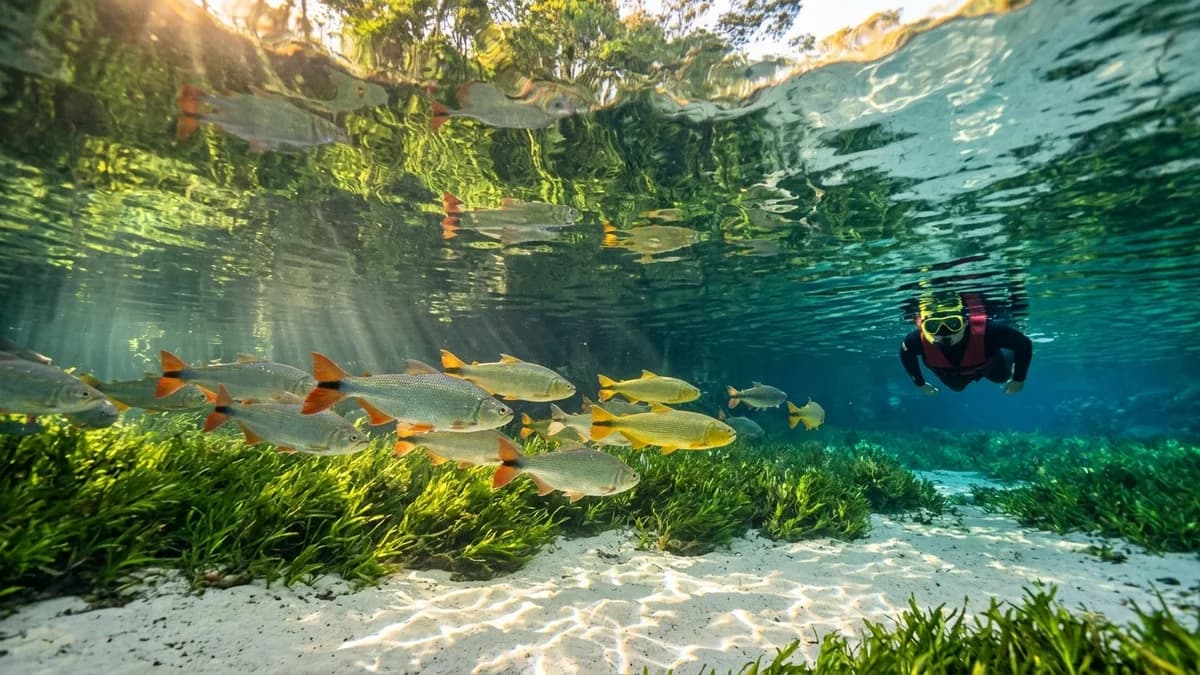
- Surface Snorkeling: Accessible from age 5, visitors float equipped with a 5mm neoprene suit, hood, mask, and snorkel. Fins are strictly prohibited during surface snorkeling to prevent accidental kicks from damaging the fragile tips of the submerged calcite cones. Propulsion is achieved through gentle arm strokes and stationary guide ropes.
- Inflatable Guide-Paddled Boat Tour: For guests who prefer not to snorkel or during rest intervals, certified guides paddle an inflatable boat along the cavern perimeter with zero motor or combustion, allowing visitors to inspect wall speleothems, cave coraloids, and rock columns up close.
- Discovery Scuba Diving (Batismo): For first-time divers without certification (minimum age 12), diving down to 8 meters depth accompanied one-on-one by a certified cavern diving instructor.
- Certified Autonomous Cavern Diving: Certified Open Water divers explore down to regulatory depths of up to 18 meters, navigating among the towering calcite cones and viewing the 18m giant anteater subfossil (visible exclusively on scuba diving, not seen from the surface boat or snorkeling). In this technical scuba modality, fins are permitted under divemaster guidance.
- Pre-Flight Surface Interval: Under international hyperbaric diving safety standards (PADI/NAUI/CMAS), scuba divers must observe a mandatory 18 to 24-hour surface interval before boarding commercial flights.
- Activity Scheduling: Scuba diving and surface snorkeling are distinct, non-simultaneous activities that cannot be scheduled in the same time slot.
6. Return to Surface, Conservation Quotas and Safety Governance
After 4 to 5 hours inside the cave, visitors are hoisted smoothly back up the 72-meter shaft to Fazenda Anhumas, where restrooms and shaded pavilions provide space to enjoy your self-packed snacks.
Preservation of Abismo Anhumas is governed by CECAV/ICMBio and Imasul, with daily capacity capped at up to 40 visitors per day. Safety protocols adhere strictly to ABNT NBR ISO 21101 (Safety Management Systems) and ABNT NBR 15285 (Guide Competencies). In adventure tourism and subterranean cave exploration, there is no zero risk; operations are governed by active residual risk management, with redundant steel anchors, automatic centrifugal brakes, emergency manual descent systems, and certified speleo-rescue protocols. Booking requires a SECTUR Single Voucher with mandatory TCA conservation fees (LC nº 162/2021) and tourist insurance.
7. Local Expert Tips and Itinerary Integration
Our team at Pousada Casa Azul recommends booking your digital voucher weeks in advance, especially during High Season holidays. To combine your speleological tour with Bonito's most famous blue cavern, consult our integrated guide to Gruta do Lago Azul and Abismo Anhumas in spring.
Key practical tips for the tour:
- Action Camera Float: Always use a wrist strap with a buoyant float for action cameras. If dropped without a float, cameras sink into 80m deep water and cannot be recovered.
- Warm Dry Clothing: Bring a small daypack with a quick-dry towel and a warm hoodie; sitting on the cave deck at 21°C in a damp suit can feel chilly.
- Bring Your Own Snacks: Fazenda Anhumas has no restaurant at the cave site; pack fruit, energy bars, sandwiches, and drinking water.
- Footwear: Wear closed-toe hiking shoes or sneakers for the approach trail to the entrance slit.
8. Lodging and Central Rest at Pousada Casa Azul
After conquering the depths of Abismo Anhumas, returning to Pousada Casa Azul in downtown Bonito provides the perfect haven of tranquility and comfort:
- Prime Central Base: Located just 23 km from Fazenda Anhumas via MS-382, our pousada places you steps from Praça da Liberdade and downtown dining along Rua Coronel Pilad Rebuá.
- Independent Accommodations: The Casa Principal offers 3 air-conditioned bedrooms, a spacious living room, and a full kitchen for families. The Chalé Romântico features a private jacuzzi for couples, both with hot showers and high-speed Wi-Fi.
- Full Kitchen & Guest Autonomy: The Casa Principal's kitchen is equipped with refrigerator, stovetop, and cookware, allowing total freedom to prepare meals and trail snacks at your own convenience.
- Tropical Garden & Swimming Pool: Unwind under swaying palms in our sparkling swimming pool to soothe leg and arm muscles after your subterranean adventure.
Frequently Asked Questions About Abismo Anhumas (FAQ)
Can non-swimmers or beginners visit Abismo Anhumas?
Yes. The 72m electric rappel is completely automated and effortless. In the lake, surface snorkeling with high-buoyancy neoprene suits is accessible from age 5, and discovery scuba diving down to 8m is conducted one-on-one by certified instructors.
Are fins allowed during surface snorkeling?
No. Fins are strictly prohibited during surface snorkeling to protect fragile submerged calcite cones from accidental kicks. Fins are permitted only for certified scuba divers under direct instructor supervision.
What is the pre-flight surface interval after scuba diving?
Scuba divers must observe a minimum surface interval of 18 to 24 hours before boarding a commercial flight or ascending to altitude, in accordance with international hyperbaric diving safety standards.
Official Sources and Scientific References
- This guide was researched and audited using verified official documents and scientific peer-reviewed studies:
- Abismo Anhumas Oficial: Operating specifications, electric rappel, lake depth and visiting rules.
- Abismo Anhumas — Speleology: Speleological history and submerged cone documentation.
- Abismo Anhumas — Accessible Tourism: Electric hoist specifications and safety redundancies.
- Abismo Anhumas — Visiting Rules: Checkpoint logistics, equipment sizing, and snack recommendations.
- CECAV / ICMBio: National Speleological Information Register (CANIE) and cave preservation standards.
- Sociedade Brasileira de Espeleologia (SBE): Cave registry, speleorescue standards and karst geology of the Bocaina Formation.
- Instituto de Meio Ambiente de Mato Grosso do Sul (Imasul): Environmental licensing, Rio Formoso watershed management, and tourist carrying capacity.
- Associação Brasileira de Normas Técnicas (ABNT): ABNT NBR ISO 21101 (Safety Management Systems) and ABNT NBR 15285 (Guide Competencies).
- Secretaria Municipal de Turismo de Bonito (SECTUR): Voucher Único regulation (Decreto nº 062/2010) and TCA regulations (LC nº 162/2021).
- CEMTEC / Semadesc MS: Official Weekly Weather Forecast Bulletin (Nov 20-23, 2026).
- Sallun Filho (2005) & Auler et al. (2001): Speleological research on the subaqueous genesis of 19m calcite cones via calcite rafts in flooded caves.
- Journal of Quaternary Science (2024, DOI: 10.1002/jqs.3656): Subfossil giant anteater (Myrmecophaga tridactyla) discovery at 18m depth in Abismo Anhumas.